



A 1907 automobile race from Beijing to Paris stretched the limits of what was possible with the technology of the era. The winning car took two months to complete the journey, traveling roads that were often barely navigable by someone on foot, let alone in a rickety automobile made half of wood. The obstacles faced by competitors in the ‘Peking-Paris’ can help make RPG car chases a lot more engaging—provided we adapt our car chases to suit our medium. Let’s look at the race, a little RPG car-chase theory, and then five cool obstacles in the Peking-Paris!
This post is brought to you by beloved Patreon backer Alamo4. Thanks—you rock!
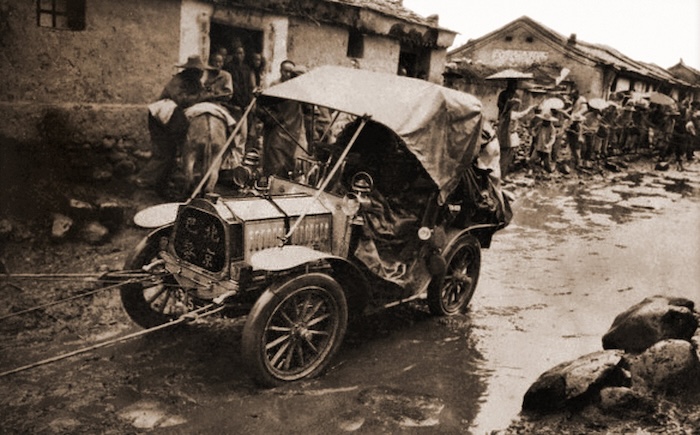
The idea for the Peking-Paris came from the Parisian newspaper Le Matin. Automobile racing was new, dangerous, and exciting. A journalist would ride in each car with the driver and a mechanic. Updates sent via telegraph and published daily would sell a lot of newspapers over the months of the race. They would also, it was assumed, boost the prestige of the French automobile industry, though the plan backfired when an Italian car won.
The race was a mess. The roads were atrocious. Fuel had to be stashed along the route in advance. One car ran out of gas in the middle of the Gobi Desert and its occupants almost died. The race started in China, which was desperately and unsuccessfully trying to stave off revolution. Most of the race was in imperial Russia, which was a chaotic police state temporarily between revolutions. All five cars (four completed the race) broke the rules at different points. Litigating these discrepancies—which ones were sensible adaptations to local conditions and which were no-good cheating—is part of the mythology of the Peking-Paris.
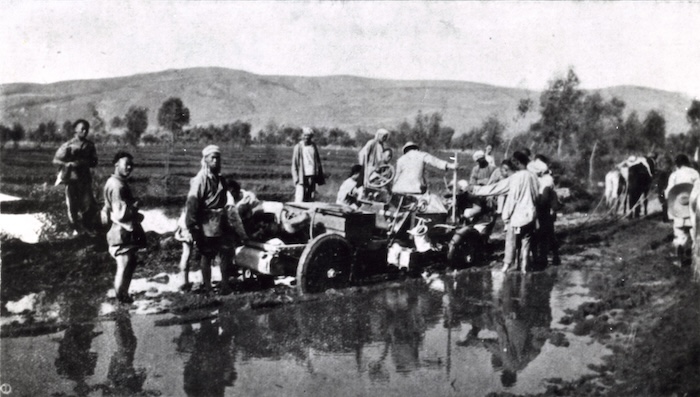
Car chases can be thrilling in movies, but I generally don’t enjoy them in RPGs. Usually they boil down to one player rolling Driving (or some equivalent) a bunch of times while the GM does the same. Advice on how to do chases and races well usually places a lot of weight on colorful description and finding excuses for people to roll other stats. In my opinion, these are just workarounds. What you really want is a solution that shifts the focus of a chase scene to something that RPGs, as a medium, do well.
The competitors in the Peking-Paris faced obstacles that RPGs do well: messy situations with multiple possible approaches, dilemmas that required problem-solving, and involvement with passers-by. I’ll get into five below. The trick, though, is that most of these obstacles only work because the race was long. This isn’t a 10-minute car chase from a Fast and the Furious. Most of these obstacles require a car chase that is at least hours long, in some cases days. That means the pursuer needs to start the chase well behind the pursued, maybe even out of sight of them, tracking and being tracked by clouds of dust, GPS transmitters, or whatever’s appropriate for your fictional setting.
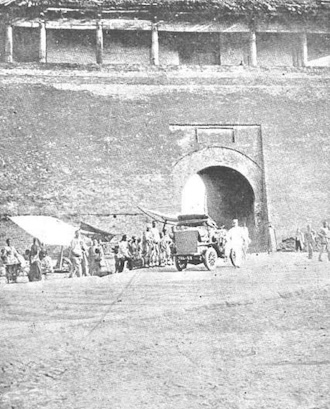
The five cars came to their first gameable obstacle almost immediately upon departing Beijing’s Tiananmen Gate. Headed north through the countryside towards the Juyong Pass and the Great Wall of China, the road crossed a river at a pair of elegant marble bridges arched almost into two semicircles. Slick marble and the steep curve gave little traction to cars sporting what were basically bicycle tires. The two 15-horsepower French cars took iron spikes, drove them between the marble blocks, attached a block and tackle, and moved their cars over with ropes. The 40-horsepower Italian car was just barely able to cross the bridges under its own power, tires squealing as it glacially mounted the slope.
At the gaming table, these two bridges can make a fun obstacle if you’re playing in a system where PCs have a bunch of special powers: something like D&D, Shadowrun, Mindjammer, or any other system where PCs have spells, technical gizmos, feats, or other ways to influence the game world that players can apply creatively. The car the party is chasing (or being chased by) doesn’t have spikes or a block and tackle. They’re gonna have to pay a crowd of laborers to haul the car over the bridges with rope. But if the party has a block and tackle, a catapult spell, or any doodad that helps them get across faster, they can gain on their opponent.
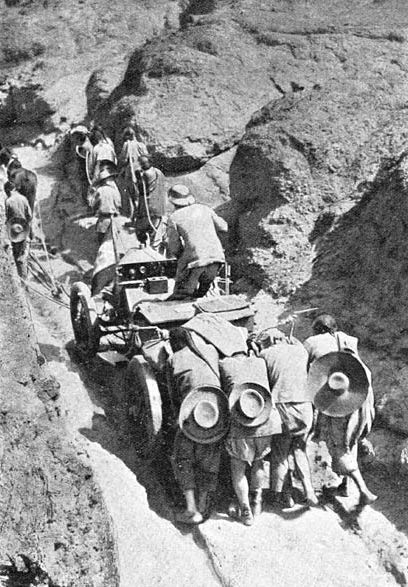
A similar incident occurred in Juyong Pass, through the mountains towards Inner Mongolia. The ancient pass was too narrow for the automobiles to get through. Drivers got out with pickaxes to widen the pass. At your table, if somebody’s got a spell or a class feature they can apply creatively, they can gain on their pickaxe-wielding opponent. Depending on which car first arrives at the pass (or the narrow gap in the walls or whatever you want to use), the relative width of the cars might matter. A car the same width as or thinner than a preceding car won’t have to stop, since the lead car already widened the gap.
When the racers reached the low grass of the eastern Gobi Desert, they found the horseman of the plateau eager to match themselves against the horseless carriages. The racers followed a line of telegraph poles across the plain, and every time that route brought them near a nomad camp, the people of the Gobi would leap onto their steeds and race alongside: a car surrounded by whooping, joyous, galloping horsemen. At the table, if your party is in the lead (being pursued), they might have to convince the horsemen—shouting to be heard over the motor and the thunder of hooves—to give the PCs space so they don’t have to slow down.

The terrain changed when the race entered Siberia. It took the racers along the Siberian Route: an unpaved dirt track cut through the dense forest to open it up to Russian colonization and imperial prison camps. The Peking-Paris was late enough in the year for the Siberian Route to have dried out from the spring “mud season,” when it was truly impassable. The trouble was that brand new Trans-Siberian Railway was mostly built along the old Siberian Route. Given that the rail was there, nobody was using the road. Maintenance was almost nonexistant in the best of times, and now there wasn’t even a regular passage of carts and foot traffic to keep the road from getting overgrown. The unused cart bridges along the Siberian route were starting to collapse. It was a mess.
So the Italian team asked the Russian government for permission to drive on the railroad bridges. They couldn’t just do it and ask permission later; the bridges were guarded lest revolutionaries blow them up. So the Italians were issued a policeman with a little red flag to ride in their car and get the guards to let them pass. The bridges were no wider than a train and had no safety railing. The Italian car simply bump-a-bump-a-bumped along, its right tire hugging the outside of the right rail while everyone inside tried not to look down.
At a river crossing a day west of Lake Baikal, the Italian team learned they couldn’t use the railroad bridge, as there was a train coming. Rather than waiting for the train to pass, they opted to use the parallel bridge from the old Siberian Route. This was a mistake. The bridge partially collapsed mid-crossing. Somehow no one was hurt and the car was not crushed. Railway workers came to winch the car out of the mess.
At your table, this is a fun conundrum. You’re faced with two bridges. One is in terrible condition. The other’s in good shape, but has an oncoming train. Do you take the good bridge and try to race the train? Do you take the bad bridge, which still comes with risks, but lower ones—but is also gonna be slower, since you have to go out of your way and then drive carefully? Or do you wait for the train to pass and then take the good bridge, thereby guaranteeing your car won’t be destroyed but also guaranteeing you’ll suffer a delay?

By mid-July, six weeks into the race, the Italian car had a 700-mile lead over the two French cars and the Dutch car. The Italians had reached European Russia and better roads. They were finally making decent time. Then one of the car’s wooden, spoked wheels—damaged early in the race—broke irreparably. To get the car into a fit state to at least reach the next village, the Italians set about reinforcing it with tied-on small branches.
Then an old peasant wandered up to them. He told them there was a wagon-maker nearby, the best in the district. Maybe he could help. The Italians slowly drove their jury-rigged automobile four miles to the wagon-maker’s forge. Explaining the issue was tricky. The Italians had picked up only a little Russian and the wagon-maker barely any English. But one of his apprentices had taught himself Latin, and the Italians knew just enough Latin to clarify points beyond “Look at this wheel and see it is clearly broken.” The Russians got to work. They made the spokes not on a lathe but with axes, hewing logs into exactly the right size and shape. The result wasn’t pretty, but it would be well-nigh unbreakable: more than sufficient to get the Italians to Paris and victory.
There were any number of mechanical breakdowns on the Peking-Paris. An engine caught fire once, and I already mentioned the crew of the Dutch car almost dying when their car ran out of fuel in the Gobi Desert. But this broken wheel is, I think, the most gameable breakdown. It starts off as a physical problem. The wheel is broken beyond what you can fix by rolling Mechanics. Does anyone have a spell or gizmo that, when cleverly applied, could fix it? If not, it becomes a social challenge. You can make it even more interesting by saying that the wagon-maker is busy with other clients, and you need to convince him to prioritize your repair over theirs.

There were plenty of other fun obstacles on the Peking-Paris, but the degree to which they were gameable depends on the sorts of options your system gives the players.
- Porters hired by one of the French cars to drag their car up a too-steep mountain road all got super high and stopped being interested in hauling the car.
- A marshland presented a labyrinth of traversable high ground and impassable mire.
- A few days before the Italian car arrived at a river crossing, its ferry had sunk. The village agreed it was time to get their ferry back in order and worked together to haul it up off the river bottom and back onshore, patch it up, and refloat it.

Make sure you don’t miss a blog post by subscribing to my no-frills monthly mailing list! I also have a signup that’s only for big product releases!
Looking for material for your game tonight? My back catalog has hundreds of great posts, all searchable and filterable so you can find something from real history or folklore that fits exactly what you need!
Come follow and chat with me on social media! On Bluesky, I’m @moltensulfur.bsky.social. On Mastodon I’m @MoltenSulfur@dice.camp.