




One of the earliest known economic bubbles was the “tulipomania” of the Netherlands in the 1630s, where tulip bulbs were bought and sold at astronomical prices. Speculators didn’t think tulips were inherently worth that much. They were just confident some other speculator would buy their tulip bulbs for even more tomorrow—because that speculator could then unload it to someone else for even more the day after that. Prices rose and rose until February 1637, when the market collapsed. While the mania was bizarre, the details are really interesting, including a central mystery: what triggered the remarkable colors that defined the most valuable tulips? We’re gonna dig into it, and then lay out how to make a B-plot for interested players in your RPG campaign inspired by Dutch tulipomania: a weird economic phenomenon with a mystery at the heart of it.
Also, I’ve got an update out about the latest with the blog and an announcement about my next standalone RPG!
This post is brought to you by beloved Patreon backer Arthur Brown. Thanks, Arthur—you rock!
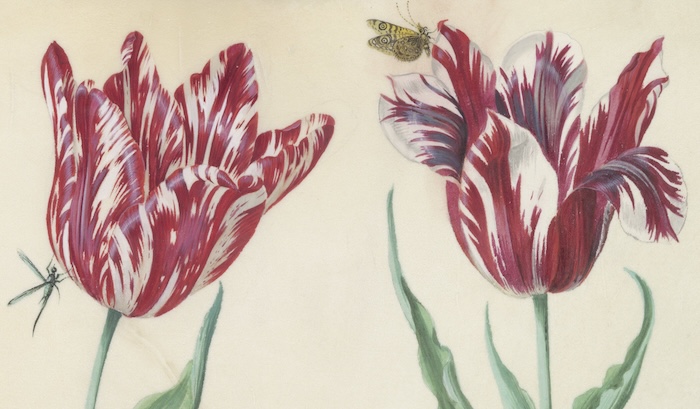
The 1600s opened with a newly-independent Dutch Republic freed from Hapsburg Spanish rule and flush with cash. A new Dutch colonial empire in Southeast Asia, a flood of rich Protestant refugees from Belgium, and a focus on commerce made the Dutch Republic wealthy, with much of that wealth concentrated in the hands of a new mercantile upper crust. These fancy lads built country estates for themselves, which needed gardens. The tulip was a new arrival in western Europe, having come over from the Ottoman Empire. Flower-lovers were struck by their vivid colors, and they became the fashionable thing to plant in Dutch gardens. Wealthy aficionados made tulips their hobby: growing them, breeding new varieties, and sending bulbs as gifts to their friends. Unsurprisingly for a hobby of the rich, the plants whose flowers were thought most beautiful could fetch high prices on the open market.
Mere loveliness cannot explain why the rich were willing to pay so much for particularly beautiful flowers. The biology of the tulip also plays a role. The underground part of a tulip, the bulb, looks a lot like an onion. Every year, a few little bulbs called offsets grow off the mother bulb of a mature tulip. Once the offsets are big enough, you can dig them up, separate them from the mother bulb, and plant them somewhere else. Offsets breed true: the shoot that grows from an offset bulb produces a flower that looks like the flower produced by the mother bulb. This is a slow process. You only get a few offsets every year. And while you can grow tulips from seed, the flowers you’ll get won’t look like the parent flowers that produced the seeds.
So when a gardener produced a lovely new variety of tulip, the only way to get more of it was to wait for it to produce offsets, replant the offsets next year, then replant the offsets those plants produced next year, and so forth. Meanwhile, every year every bulb of these long-lived plants sent up a beautiful flower that aficionados would come and marvel at. Supplies of exciting new varieties of tulip were very limited, and the process of making more produced beautiful flowers that further intensified demand.
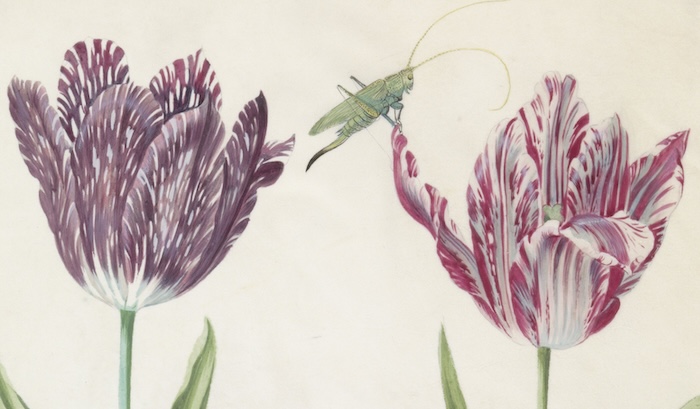
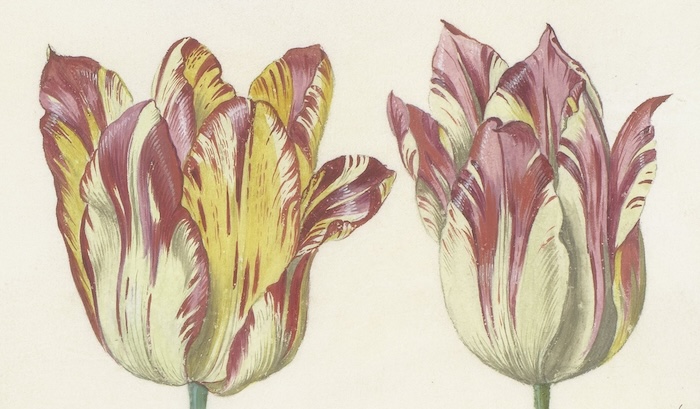
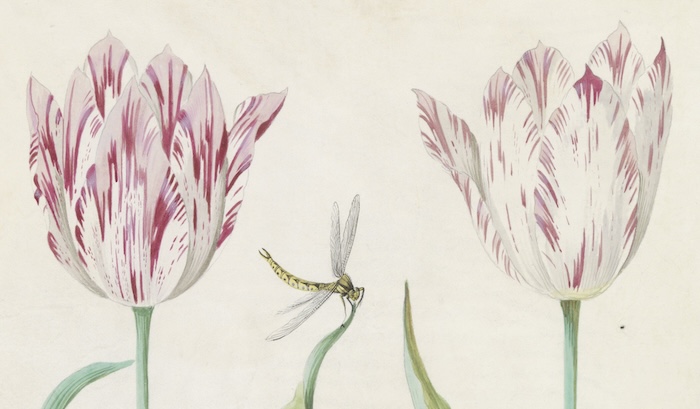
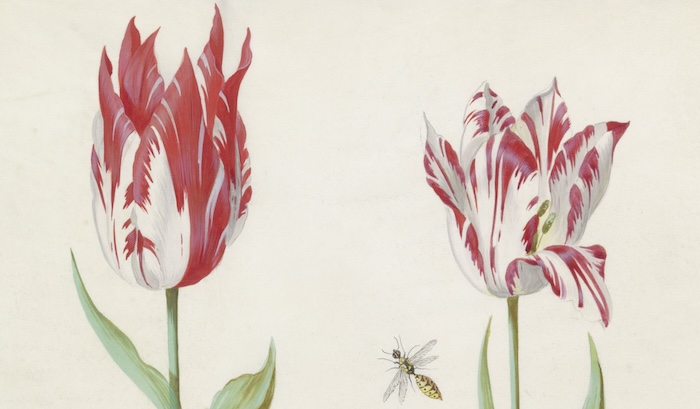
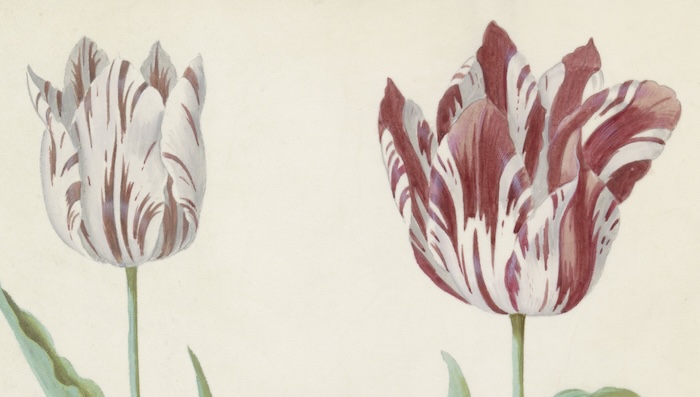
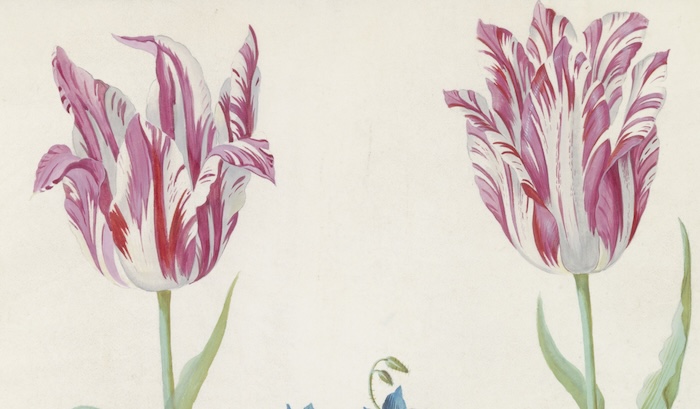
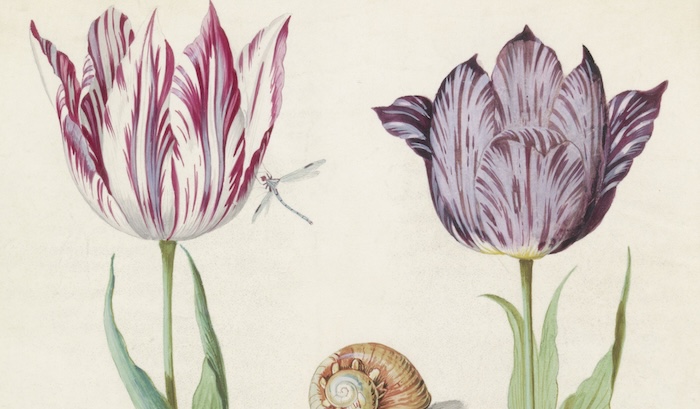
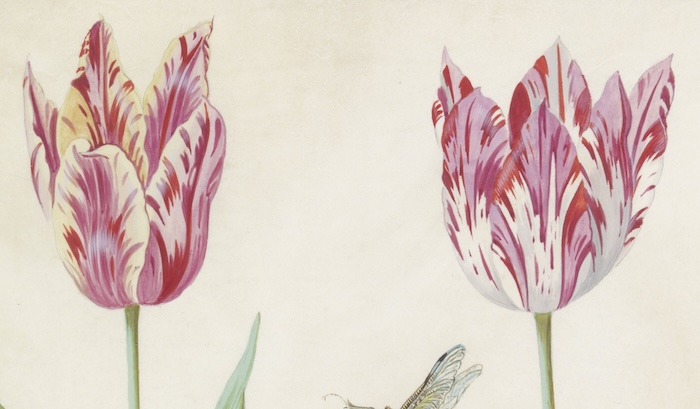
But the best tulip varieties didn’t come from intentional breeding. They came from a mysterious, seemingly-random process called “breaking.” Most tulips produce petals in one vibrant color. A broken tulip has multiple colors per petal, in delicate striations, the colors even more intense than in a non-broken counterpart. (All the flowers in the illustrations in this post are broken.) The Dutch loved broken tulips that had veins of color running through otherwise-pale petals.
The offsets of a broken bulb were usually—but not always—also broken, and patterned in the same fashion as the flower of the mother bulb. Seeds from broken tulips never sprouted as broken plants. A plant might grow as un-broken for years, then emerge one spring suddenly broken, never to be a solid color again, while the plants beside it continued unchanged. Broken plants were weaker than their non-broken counterparts. They lived shorter lives and produced fewer offsets. The same characteristic that made broken tulips desirable also made them rarer and slower to propagate. The stronger the breaking of the color, the more desirable the flower—and the weaker the plant and the fewer the offsets. And no one could figure out what caused a bulb to break or how to induce it.
The demand for tulips, especially the best-regarded broken varieties, meant growers got into business supplying them. It wasn’t hard to be a tulip-grower. Tulips love the Dutch soil and climate. The bulbs are easy to transport, which makes them easy to sell. After the plant flowers in spring, it dies back and the bulb goes dormant. The plant actually benefits from having its bulb dug up in summer for a few months, so summer was the season to buy and sell tulip bulbs. This was just another expensive hobby of the rich—until the speculators came.
Dutch culture in the 1600s well understood that money bred money. Merchants took their profits and plowed them into new endeavors, growing their bank accounts. Ships to the East Indies often returned 400% profit. Bonds for dikes to push back the sea and expose more farmland produced reliable revenue. There were even savings accounts that paid interest.
All of these were off-limits to the Dutch working class. Many families did a good job saving a few guilders here and there so they could buy something big. But a family of artisans or farmhands would never be able to save enough money to buy a share in a ship or a land-reclamation project. For the amounts the poor could save up, businessmen literally didn’t want their money.
But anyone could buy a tulip bulb. Oh sure, you couldn’t save up enough to buy a Semper Augustus bulb that sold for thousands of guilders. But you could buy a mid-rank Witte Croon, plant it in your herb garden, and sell next year’s offsets. Most trade was restricted by guilds, but there was no guild of tulip-growers to stand in your way. In the early 1630s, tulips were one of the few investment vehicles available to Dutch artisan families. So now artisan families were also bidding on tulip bulbs, alongside the wealthy aficionados, which drove bulb prices higher still. It wasn’t a bubble yet, but the price of a bulb was starting to get disconnected from the actual value of that bulb to an aficionado—the only person who wanted the plant for something other than an investment vehicle.
As prices rose, non-gardeners got into the market. They didn’t want to buy a tulip and grow it, either for beauty or to breed more tulips. No, they wanted to buy a tulip bulb, wait for the price to rise, and then sell it to someone else. And if they didn’t actually want the physical bulb—didn’t even care about the physical bulb—then buying and selling could happen outside the summer season when the bulbs were out of the ground. These people too were mostly of the artisan class: weavers, masons, and the like.
What speculators were buying and selling was essentially a tulip future: a promise to, next summer, provide a bulb of a particular variety and weight for a specified amount. Once you’d bought a tulip future, confident you’ll get that tulip, you could turn around and sell the tulip you’d been promised to somebody else. On the magic day, they’d give you an amount of money that was bigger than the amount of money you’d promised the person you bought your future from. You’d pay your debt, pocket the difference, and pass your new bulb to the person who’d bought it from you. These speculators formed clubs that met in the back rooms of taverns and did all their futures trading drunk. There was no way for buyers to know if the sellers actually owned the futures they were selling, and no way for sellers to know if the buyers were actually good for the money. Since everyone believed that prices could only go up, they bought and sold as if it were so, which actually did drive prices up. From 1634 to 1636, a lot of people made a lot of money—or at least possessed pieces of paper with ever-larger numbers on them.
Serious merchants did not participate in the tulip trade, nor did the vast majority of artisans. It was the realm of perhaps a couple ten thousand weirdos, who were all playing with money they didn’t actually have. There was no regulation, not even the customs of the Dutch stock exchange. Many of the wealthy aficionados cut back on their tulip purchases, unwilling to pay the rising prices. But by late 1636, that no longer mattered; the trade was entirely disconnected from the actual good being bought and sold.
The market collapsed in February 1637. It failed first in Haarlem, on February 3rd, when a routine auction failed to find any buyers. The auctioneer started the bidding over again and again at ever-lower prices, but no one would bite. With that, the tulip speculators of Haarlem realized there would be no one coming to buy their futures contracts at an even higher price than what they’d paid. The market in Haarlem disappeared almost overnight, leaving all these speculators tens of thousands of guilders in debt to one another. The crashes in the other cities of the Dutch Republic were less spectacular, with trade gradually petering out rather than vanishing in an instant.
The governments of the Dutch Republic (the cities, the provinces, and the States General in the Hague) saw that a tsunami of lawsuits were coming, and would overwhelm the courts. Because the tulip speculators were people on the fringes of the Dutch economy, folks in government didn’t understand the tulip crisis well enough to issue useful laws about it. Instead, they issued a variety of contradictory instructions before settling on the easiest one: all tulip-related contracts were void. Speculators couldn’t pursue the people who owed them money, and couldn’t be pursued for the same.
All those paper profits and paper losses just vanished. Some individuals probably walked away from “tulipomania” with fortunes, if they happened to sell and get paid at the right time. Some probably walked away entirely ruined, having mortgaged their homes, farms, tools, furniture, and even clothing on contracts that weren’t voided. Some of those folks probably starved to death. But despite the scale of the hysteria, it was mostly a wash. Most speculators walked away from tulipomania in about the same shape that they walked in. The growers lost out, since they’d paid to put in new beds to grow more tulips. The aficionados found the whole affair embarrassing, since their hobby had triggered the mania. But the impact on the broader Dutch economy was almost zero.
But what about the mystery of what made flowers break? And what about my promise of a B-plot?
A B-plot is a story that runs parallel to the main story of a campaign. For example, I’m in a Dragonbane campaign that’s nearing its end. The main thrust of the campaign is leaving a town to go into different dungeons in the wilderness. But there’s also been a B-plot where we’ve known that someone in town is a secret cultist who’s been passing information to the big bad. Every time we come back to town, we get to interact with this plot a little bit: learning what’s happened in town while we were in the wilderness and how what we reported last time we were in town impacted events. Eventually we were able to piece together enough information about how the townsfolk reacted to us to determine who the secret cultist was. In short, a B-plot in that sort of RPG is a plot that unfolds over many sessions in little bits and pieces, and that you can pick up and put down as the main story demands.
At its core, the gameable experience at the heart of Dutch tulipomania is a weird economic phenomenon with a mystery at its heart. So that’s what you need to make it work as a B-plot. While the party does whatever they usually do, there’s some sort of ongoing weird economic thing happening—probably a bubble, just because it’s easy to implement. Base the bubble around something at least one of the players finds interesting. The best way to do that (in my opinion) is to look at their character sheets, their backgrounds, the NPCs they’ve befriended, and the times they have explicitly told you “I would like to see more about X.” (You are gathering feedback from your players, right?) In short, you want to build a weird economic phenomenon that will make at least one player want to engage with it, because it has things they like. If the players aren’t interested, this won’t work. You can’t force it.
Then you need the mystery at the heart of it. In tulipomania, it’s what makes some tulips break and become fabulously valuable. Again, keep it simple. Tie the wildest part of your bubble to something whose cause is unknown. Explicitly tell the players that if they feel like investigating, there’s something there. If they don’t feel like investigating that mystery, don’t put any more work into it.
In real life, tulip breaking is caused by a virus. The tulip-breaking virus messes with how pigment is produced in the petals. It’s also damaging to the plant itself; that’s why broken tulips are so sickly. Almost all the varieties of tulip that fetched such high prices in the Netherlands in 1637 are extinct. They just die too easily. The virus is transmitted by aphids. An aphid feeds on a broken tulip, gets the virus on its sharp-straw mouth (stylet), and when it goes to feed on a non-broken tulip, that tulip might get infected. Or it might not—anything involving the immune system is unpredictable.
In your campaign, tie your mystery to a key element of your fictional setting. In Runequest, spirits are behind it. In Deadlands, it’s ghost rock. In Star Trek, it’s something to do with the warp drive. There can be a temptation to be very clever with your solution. I promise, your players will not be as impressed by your cleverness as you are, and since they don’t think like you, they might never actually figure out a particularly “clever” solution. It’s better to keep your campaign thematically unified, which produces a more satisfying solution to the mystery.
Whatever solution you use for your mystery, make it so that gathering information to solve it will take a long time. It may require experiments that take days or months to run while the party is elsewhere. It may require collecting data from black holes that you fly past in your travels. These are things that can run in the background while the party advances the main story.
Because what the party is doing has major economic implications, NPCs can seek them out. Some speculators may want to help the party, believing that by being the first to know the solution they might make a killing. Some speculators may try to stop the party, since solving the mystery may pop the bubble. Set a scene of the main story in one of the strange speculator clubs. Make the speculators weird and memorable; in tulipomania these were folks on the fringe. Additionally, important people might want to talk to the party about what the PCs are up to, letting you fold them into the campaign organically, even while fending off threats from opposing speculators.
Then there’s the payoff. Once the party has figured out what’s behind the mystery, the players get to decide what they’re gonna do with that information. If they can keep it secret, it’s probably a license to print money—which of course means that criminals, governments, and mercenaries hired by the wealthy will all be coming after the party, which is just peachy. Eventually the bubble pops. Unless the party takes pains to avoid it, whoever was left holding the bag when the market collapsed will probably blame the PCs.
Don’t forget to check out my update on the latest with the blog and an announcement about my next standalone RPG!
One of my earliest RPG products, The GM’s Real-World Reference included a section on tulipomania. I suspect my coauthor and friend Joel wrote that section, because it’s held up well. I’ve debated whether I want to keep The GM’s Real-World Reference available for sale. It’s not representative of the current quality of my work, and not all its contents have aged outstandingly (though Joel’s work has aged better than mine). That said, sometimes people buy a copy, and who am I to turn down their money?
Make sure you don’t miss a blog post by subscribing to my no-frills monthly mailing list! I also have a signup that’s only for big product releases!
Looking for material for your game tonight? My back catalog has hundreds of great posts, all searchable and filterable so you can find something from real history or folklore that fits exactly what you need!
Come follow and chat with me on social media! On Bluesky, I’m @moltensulfur.bsky.social.
Check out Shanty Hunters, my award-winning TTRPG about collecting magical sea shanties in the year 1880, then singing them at the table with your friends. The lyrics of the shanties come to life and cause problems for you and for the crew of the ship you sail aboard. It’s up to you to find clues in the song and put things right!
Source: Tulipomania: The Story of the World’s Most Coveted Flower and the Extraordinary Passions it Aroused by Mike Dash (1999)